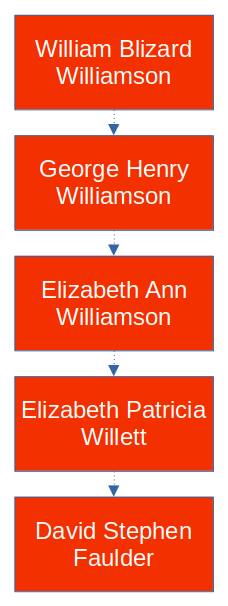
William Blizard Williamson seems to have been man who “made good”. He started as a tin man (the 1841 Census for Kingston upon Thames in England has him listed as “I tinman”, where the “I” could stand for “independent” of “Itinerant” – or both).
A search of Newspapers and stories handed down through the family, suggest that alcohol may have been an issue.
This post traces my line back through my mother’s adoptive maternal line, specifically her maternal grandfather’s surname line, the Williamsons.
It was written to try and bring some order to a variety of posts concerning the Williamsons. I am organising them into two categories: purely genealogical (i.e. relationships etc.) such as this post and “stories” related to one or more Williamsons.
First I need to establish my oldest proven Williamson ancestor, stepping back a generation at a time. This post covers the ancestry in England and a later post the ancestry in Ireland.
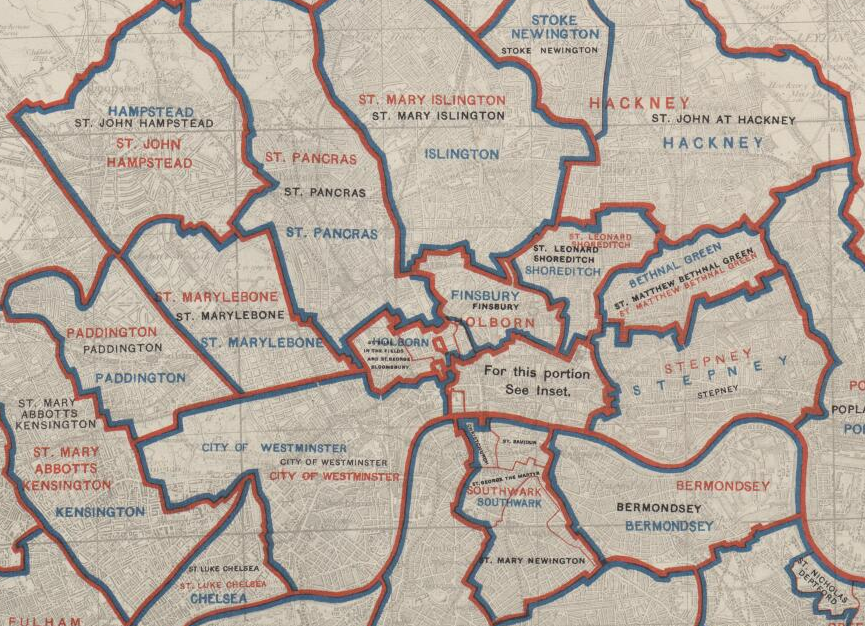
Researching the genealogy of people born, marrying, dying or residing in “London” is often confused by what is meant by “London”. The discussion below is based on the following sources:
Acts of Parliament (applying to England and Wales) referenced in Wikipedia sources.
London Gazette announcements referenced in the reference lists of the Wikipedia Sources.
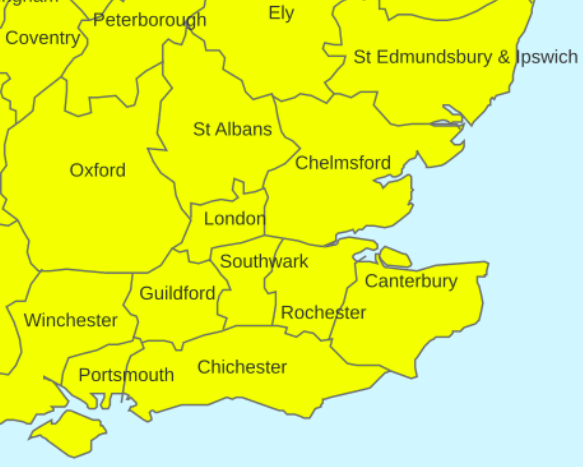
Ecclesiastical
Prior to Civil Registration (from 1837), the Church of England parish churches acted as “registrar’s office” for nearly all faiths and denominations. A church’s parish registers recorded baptisms, marriages and burials. These would be periodically transcribed and sent to the Diocese as “Bishop’s Transcripts”.
Parishes were usually grouped within Deaneries within Archdeaneries within Dioceses.
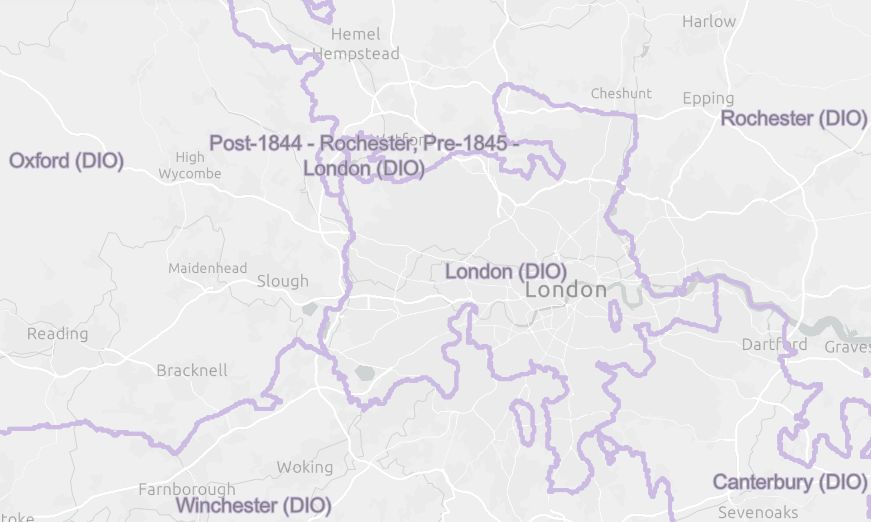
The Family Search website carries a snapshot of “1851 jurisdictions” showing (by map) ecclesiastical parishes, deaneries and dioceses, together with counties and registration districts at that time.
parishes in Northern Parts of Surrey previously in Winchester Diocese and
“a small part near the southern end of the London Bridge” in the Diocese of London (the medieval London Bridge was part of the City of London’s Bridge Ward),
now broadly covering London south of the Thames and East Surrey
The Metropolitan Board of Works was a short-lived organisation. It was an indirectly elected board responsible for infrastructure works in the “Metropolis of London”, corresponding to later Inner London.
The County of London 1889-1965
The County of London – established in 1889 roughly corresponds to the inner boroughs of what is now Greater London.
Modern London Boroughs covering the area of the former County of London within modern Greater London Wikipedia: CC BY-SA 3.0
The London Government Act 1899 merged former districts and parish vestries into 24 Metropolitan Boroughs.
Greater London (Council: 1965 to 1986) Greater London (Authority: 2000 to Present)
In 1965, The Counties of London and Middlesex were brought together with some boroughs in Surrey, Essex and Kent to form “Greater London”.
Summary of Movements in and Out of “London”
The table below helps to summarise movement of areas between London and the Counties surrounding it and amalgamations of boroughs.
Local Govt Act 1888 created in 1889:
Local Govt Act 1963 created in 1965
Surrey to London
New London Boroughs of: Lambeth Southwark Wandsworth
New Outer London Boroughs of: Croydon (1889 County Borough) Kingston Merton Sutton Richmond (S of Thames)
Surrey to London to Kent
Penge, a parish of Battersea (Surrey) but electing members to the Lewisham Board of Works, and was consequently transferred to London in 1888. The London Government Act 1899 caused the area to be moved to Kent as Penge Urban District
Middlesex to Surrey
Borough of Spelthorne consisting of: Sunbury-on-Thames Urban District and Staines Urban District
Middlesex to London
NewLondon Boroughs in 1889 rationalised in 1965 into: Inner London Boroughs of: Camden formed from: Hampstead Holborn St Pancras. Hackney formed from: Hackney Shoreditch Stoke Newington Hammersmith (from 1979, named Hammersmith and Fulham) formed from: Hammersmith Fulham Islington formed from: Finsbury Islington Kensington and Chelsea formed from: Chelsea Kensington Tower Hamlets formed from: Bethnal Green Poplar Stepney The City of Westminster formed from: Paddington St Marylebone The City of Westminster From 1900: South Hornsey (enclave)
Outer London Boroughs (from 1965): Barnet (part only), Brent Ealing Enfield Haringey Harrow Hillingdon Hounslow Richmond (N of Thames)
Middlesex to Hertfordshire
Parish of Monken Hadley
Hertsmere (part: Potters Bar Urban District)
Essex to London
New Outer London Boroughs of: Barking and Dagenham formed from: most of Barking Dagenham Havering formed from: Romford Hornchurch Redbridge formed from Ilford Wanstead & Woodford part of Dagenham part of Chigwell Waltham Forest formed from: Chingford, Leyton Walthamstow New London inner borough of: Newham formed from: East Ham(1915 County Borough) West Ham (1889 County Borough)
Essex to Cambridgeshire
Parishes of Great Chishill, Little Chishill and Heydon
Kent to London
NewLondon Boroughs in 1889 rationalised in 1965 into Inner London Boroughs of: Greenwich formed from: Greenwich Woolwich Lee Eltham Charlton Kidbrooke Lewisham formed from: Lewisham Deptford
New outer London Boroughs of: Bexley Bromley
(Penge Urban District (see “Surrey to London to Kent” above) merged with others to form London Borough of Bromley)
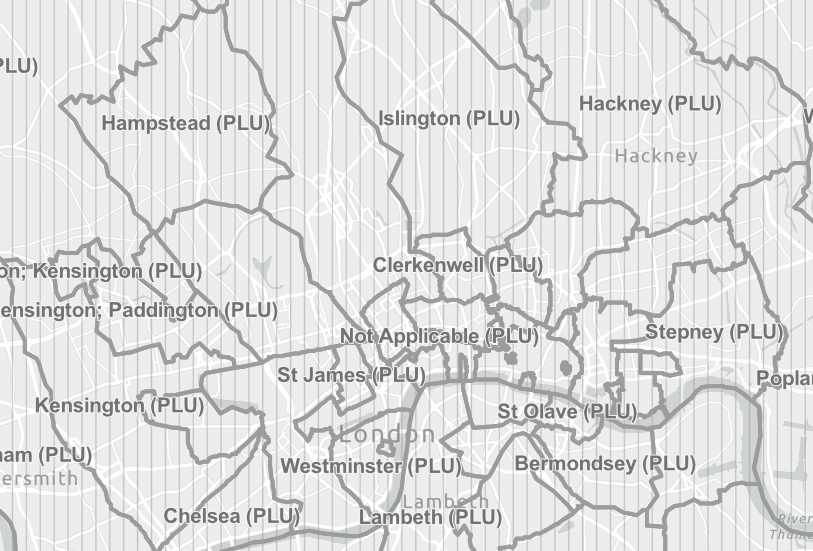
Registration Districts
Registration districts were set up in conjunction with the beginning of civil registration in 1837 (Births and Deaths Registration Act 1836) and used for registering records of births, marriages and deaths. They were also used for collation of census information.
These districts matched the Poor Law Unions set up in 1834 (Poor Law Amendment Act 1834) and which existed until the 1930s when the system of County Boroughs and Administrative counties was set up.
Prior to the Poor Law Unions, the power to “set a rate” for the “relief of the poor” was given to parishes by the 1601 Poor Relief Act. These were ecclesiastical parishes of the Church of England “taken over” from the Catholic Church at the time of the Reformation.
The 1662 Poor Relief Act, recognised that many parishes were too large to effectively manage poor relief and in practice this was split across townships which levied separate rates.
The Poor Law Amendment Act 1866 directed that any rate levying areas (ecclesiastical parishes & chapelries, townships or extra-parochial areas) were “parishes”. This is the source of the term “civil parishes”.
The 1834 Act defined Poor Law Unions as groups of these civil parishes. If a Poor Law Union consisted of a single parish, that parish became known as a poor law parish.
Through various changes the boundaries of ecclesiastical and civil parishes have diverged.
Application to those parts of London of interest in respect of the Williamsons.
The Poor Law Unions in Middlesex seemed to have been relatively stable through the 19th century with only a few parishes being moved between Unions. This covers the areas where George Henry Williamson may have been born in 1845.
Villett and similar (Villet, Vilette etc.) as a variation of Willett were excluded from my ongoing “Willetts in Essex” analysis. Villett and variants does often appear in discussion of Huguenot Families, and given the suggestion that the Willetts may be of Huguenot origin, it is accepted that research may have to be expanded. This post looks at the distribution of “Villett” and similar in Essex.
My mother’s adoptive mother’s paternal grandfather (my Grandmother’s Grandfather) was William Blizard Williamson (born Cork, Ireland 1811, died Worcester, England 1878). He had two sons: William Blizard Williamson (the younger) and George Henry Williamson – my grandmother’s father.
I have written previously about them. This post ponders the origin of the Blizard name in our family tree and whether knowing that helps identify further ancestors or the geographical origin of the Williamsons. (There is a rumour that they may have originated in England and another that they originated in Londonderry.)
This post summarises what I know about the name (not much) and what I would like to know. It is a work-in-progress both in terms of research and content editing. Suggestions are very welcome!
This post also details the genealogy of Sir William Blizard (1743-1835), a surgeon and founder of the first medical school attached to a hospital, The London Hospital. It may be that William Blizard Williamson was named after this famous person, but if anyone reading this identifies a genealogical link between the two of them … .
On the other hand, perhaps he was born during a blizzard?
On 5 April 1981 the 1981 UK Census was taken. Normally this is not a particular issue but for my mother it was. She was adopted but had traced her birth mother. On the approach to Census night she realised that she would be staying with her birth mother that night so would be listed as a “visitor” on her mother’s household census form.
This meant her mother would have to record their relationship. In 1981 this was “a secret” and left my mother in a quandary; knowing her mother had promised her (later) husband that she would keep my mother’s existence a secret but also knowing she wanted to be honest – how could she complete the form?
This post, and its pair, is in response to a comment about a possible relationship between the Willetts (from Colchester – “my ancestors”, as researched elsewhere on this website) and a line of Willetts in the East End of London. The key link seems to be a George Willett born around 1862 or 1863.
This post examines how I am related to this George Willett. A second post looks at the other line.
This post, and its pair, is in response to a comment about a possible relationship between the Willetts (from Colchester – “my ancestors” as researched elsewhere on this website) and a line of Willetts in the East End of London identified by Lee Willett. The key link seems to be a George Willett born around 1862 or 1863. Branches of the Colchester Willetts migrated to the East End.
The first post revalidated how I am related to the George Willett born in Whitechapel – a descendant of Everard Willett of Colchester. This post examines how Lee’s ancestors may be related to this George Willett.
“On the night of 18th May 1918, members of the St Omer Convoy were called out to evacuate patients after a bombing raid had hit a local ammunition dump.”
The FANY as they are almost always know were the First Aid Nursing Yeomanry, a group of predominantly women with the possibly fanciful idea of combining their horsewomanship and first aid ability to be of service to the British military. They envisaged they could gallop out on to the battlefield to retrieve the wounded and carry them back to the lines where First Aid could be applied. In reality this romantic idea evolved rapidly in World War One into driving heavy motor ambulances – initially for the French and Belgians because the British wanted nothing to do with them.
Users can no longer access this website via faulder.eu as the domain has been summarily withdrawn because the UK (in the infinite wisdom of our new leader but now so many ago) has stupidly withdrawn the UK from the EU. This is a very minor part of the cake that we cannot have and eat. (EU Notice)
Anything you read from now on (after 31 December 2020) found directly on faulder.eu is nothing to do with me and I have no control over it.
Anything on the Internet Archive prior to 31 December 2020 should be a copy of faulder.org.uk for that date.
People who have prior to 31 December 2020 used email addresses on the faulder.eu domain should now use the same email account but on the faulder.org.uk domain.
The faulder.org.uk domain is unaffected.
The faulder.org domain should mirror faulder.org.uk