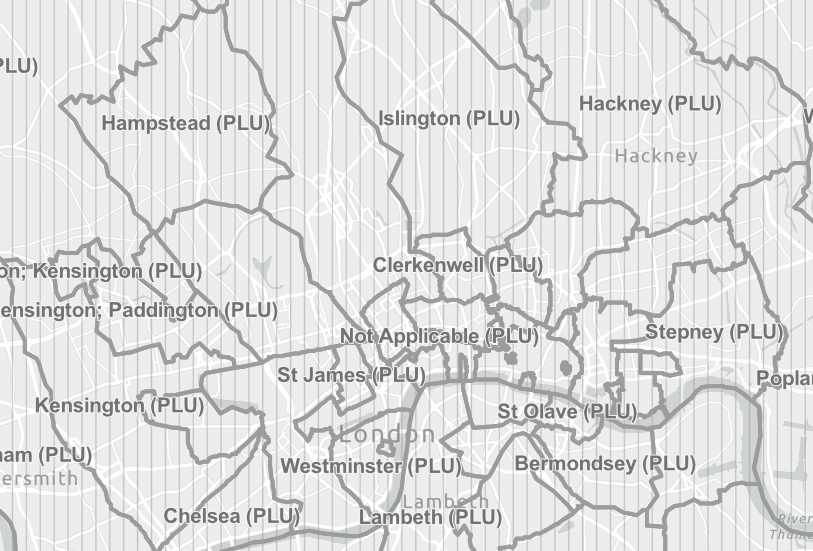
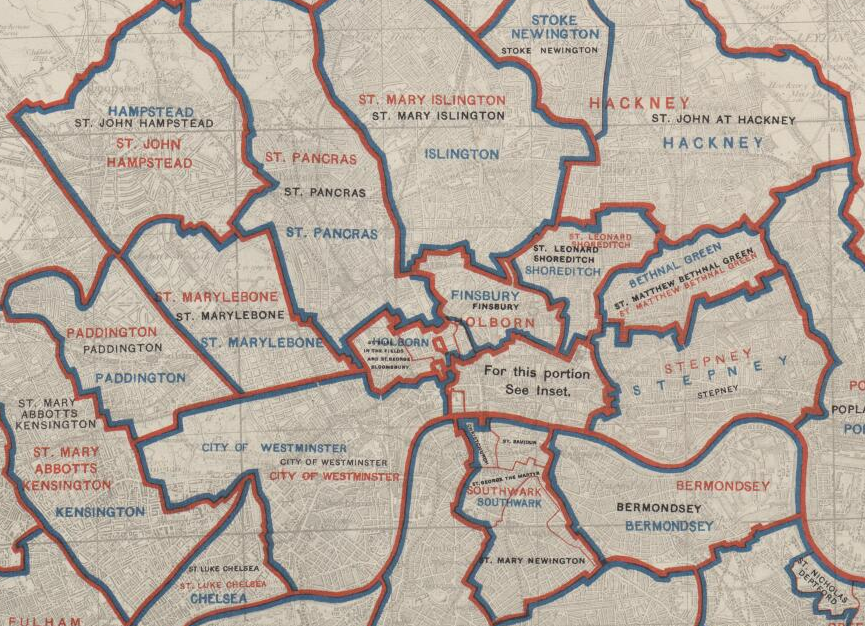
Researching the genealogy of people born, marrying, dying or residing in “London” is often confused by what is meant by “London”. The discussion below is based on the following sources:
- Wikipedia (History of Local Government in London and other pages)
- Family Search “1551 Jurisdictions” map
- UKBMD
- Acts of Parliament (applying to England and Wales) referenced in Wikipedia sources.
- London Gazette announcements referenced in the reference lists of the Wikipedia Sources.
Ecclesiastical
Prior to Civil Registration (from 1837), the Church of England parish churches acted as “registrar’s office” for nearly all faiths and denominations. A church’s parish registers recorded baptisms, marriages and burials. These would be periodically transcribed and sent to the Diocese as “Bishop’s Transcripts”.
Parishes were usually grouped within Deaneries within Archdeaneries within Dioceses.
The Family Search website carries a snapshot of “1851 jurisdictions” showing (by map) ecclesiastical parishes, deaneries and dioceses, together with counties and registration districts at that time.
Diocese of London
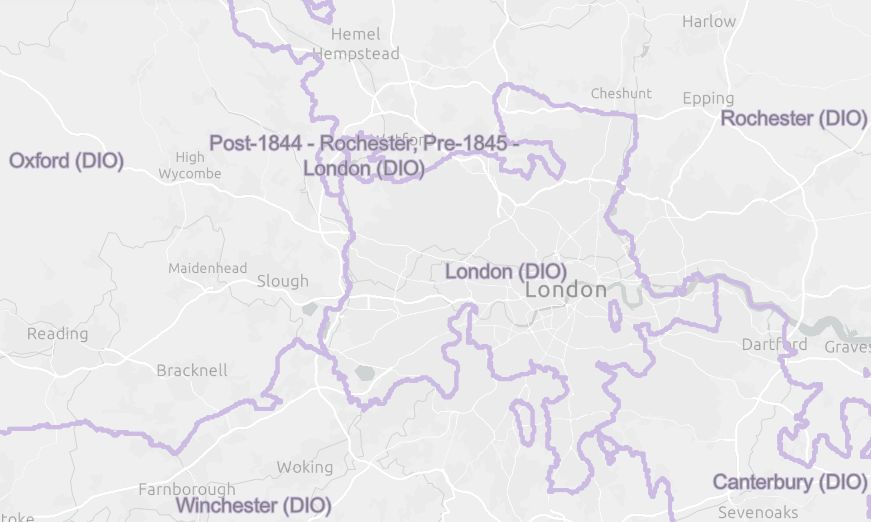
- 604: Founded covering Middlesex, Essex, and parts of Surrey (reaching South to include modern-day Croydon)
- 1846: Essex Parishes moved to Rochester
- later to St Alban’s
- 1914: formed Diocese of Chelmsford
The Current Diocese of London lies to the North of the Thames and now covers an area nearly equivalent to the historic county of Middlesex.
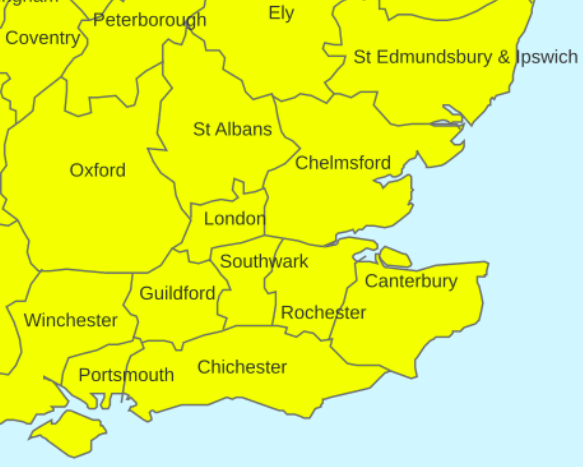
CC BY-SA 3.0
Its neighbours are:
- Southwark Diocese
- 1905: formed from part of Rochester Diocese:
- parishes in Northern Parts of Surrey previously in Winchester Diocese and
- “a small part near the southern end of the London Bridge” in the Diocese of London (the medieval London Bridge was part of the City of London’s Bridge Ward),
- now broadly covering London south of the Thames and East Surrey
- 1905: formed from part of Rochester Diocese:
- Guildford Diocese
- 1927: formed from the North East of Winchester Diocese:
- the then Archdeaconry of Surrey and
- a number of parishes in NE Hampshire
- now covering:
- 8½ (western) districts (of 11) in modern Surrey, excluding:
- Spelthorpe – in Diocese of London
- Tandridge – in Diocese of Southwark
- Redhill & Reigate part of Reigate & Banstead – in Diocese of Southwark
- parts of North West Hampshire,
- Rushmoor
- Eastern parishes in the District of Hart
- one Greater London parish (Chessington).
- 8½ (western) districts (of 11) in modern Surrey, excluding:
- It is now split East & West into two Archdeaconries:
- 1927: formed from the North East of Winchester Diocese:
- Oxford Diocese
- 1542: formed from part of the Diocese of Lincoln
- 1836: Archdeaconry of Berkshire transferred from Diocese of Salisbury
- 1837: Archdeaconry of Buckingham transferred from the Diocese of Lincoln
- now covering modern counties of Oxfordshire, Buckinghamshire & Berkshire plus:
- three churches from Bedfordshire
- and one each from both Middlesex and Hampshire
- St Albans Diocese
- 1877: formed from parts of Diocese of Rochester (parishes in Essex and Hertfordshire)
- 1914: Archdeanery of Bedford (covering most of Bedfordshire) transferred in from the Ely Diocese
- 1914: Essex parishes removed to form Chelmsford Diocese
- now covering modern counties of Hertfordshire and Bedfordshire and small parts of London (Barnet)
- Rochester Diocese
- 604: Created
- 1846: added those parishes in Essex which were previously part of London Diocese;
- 1846: added those parishes in Hertfordshire:
- Southern parts of Hertfordshire from London Diocese
- Northern parts of Hertfordshire from Lincoln Diocese
- 1877: Essex and Hertfordshire parishes moved to St Albans Diocese
- 1877: added parishes in Northern Parts of Surrey from Winchester Diocese and Diocese of London
- 1905: the above parishes moved to form Diocese of Southwark
- now covering West Kent and London Boroughs of Bexley & Bromley
- Chelmsford Diocese
- 1914 formed from St Albans Diocese – County of Essex and the Kent parish north of the Thames (North Woolwich – now in the London Borough of Newham)
- now covering
- Essex and North Woolwich (a small part of Kent north of the Thames)
- Parts of East London – The Barking Episcopal Area covering the Archdeaconries of
- West Ham (Deaneries of Newham, Redbridge, and Waltham Forest) and,
- Barking (Deaneries of Barking & Dagenham and Havering)
- London Boroughs with the names of those deaneries are those which were created in 1965 from Essex

Administratively
Metropolitan Board of Works 1855-1889
The Metropolitan Board of Works was a short-lived organisation. It was an indirectly elected board responsible for infrastructure works in the “Metropolis of London”, corresponding to later Inner London.
The County of London 1889-1965
The County of London – established in 1889 roughly corresponds to the inner boroughs of what is now Greater London.

Wikipedia: CC BY-SA 3.0
The London Government Act 1899 merged former districts and parish vestries into 24 Metropolitan Boroughs.
Greater London (Council: 1965 to 1986)
Greater London (Authority: 2000 to Present)
In 1965, The Counties of London and Middlesex were brought together with some boroughs in Surrey, Essex and Kent to form “Greater London”.
Summary of Movements in and Out of “London”
The table below helps to summarise movement of areas between London and the Counties surrounding it and amalgamations of boroughs.
| Local Govt Act 1888 created in 1889: | Local Govt Act 1963 created in 1965 | |
|---|---|---|
| Surrey to London | New London Boroughs of: Lambeth Southwark Wandsworth | New Outer London Boroughs of: Croydon (1889 County Borough) Kingston Merton Sutton Richmond (S of Thames) |
| Surrey to London to Kent | Penge, a parish of Battersea (Surrey) but electing members to the Lewisham Board of Works, and was consequently transferred to London in 1888. The London Government Act 1899 caused the area to be moved to Kent as Penge Urban District | |
| Middlesex to Surrey | Borough of Spelthorne consisting of: Sunbury-on-Thames Urban District and Staines Urban District | |
| Middlesex to London | New London Boroughs in 1889 rationalised in 1965 into: Inner London Boroughs of: Camden formed from: Hampstead Holborn St Pancras. Hackney formed from: Hackney Shoreditch Stoke Newington Hammersmith (from 1979, named Hammersmith and Fulham) formed from: Hammersmith Fulham Islington formed from: Finsbury Islington Kensington and Chelsea formed from: Chelsea Kensington Tower Hamlets formed from: Bethnal Green Poplar Stepney The City of Westminster formed from: Paddington St Marylebone The City of Westminster From 1900: South Hornsey (enclave) | Outer London Boroughs (from 1965): Barnet (part only), Brent Ealing Enfield Haringey Harrow Hillingdon Hounslow Richmond (N of Thames) |
| Middlesex to Hertfordshire | Parish of Monken Hadley | Hertsmere (part: Potters Bar Urban District) |
| Essex to London | New Outer London Boroughs of: Barking and Dagenham formed from: most of Barking Dagenham Havering formed from: Romford Hornchurch Redbridge formed from Ilford Wanstead & Woodford part of Dagenham part of Chigwell Waltham Forest formed from: Chingford, Leyton Walthamstow New London inner borough of: Newham formed from: East Ham (1915 County Borough) West Ham (1889 County Borough) | |
| Essex to Cambridgeshire | Parishes of Great Chishill, Little Chishill and Heydon | |
| Kent to London | New London Boroughs in 1889 rationalised in 1965 into Inner London Boroughs of: Greenwich formed from: Greenwich Woolwich Lee Eltham Charlton Kidbrooke Lewisham formed from: Lewisham Deptford | New outer London Boroughs of: Bexley Bromley (Penge Urban District (see “Surrey to London to Kent” above) merged with others to form London Borough of Bromley) |
Registration Districts
Registration districts were set up in conjunction with the beginning of civil registration in 1837 (Births and Deaths Registration Act 1836) and used for registering records of births, marriages and deaths. They were also used for collation of census information.
These districts matched the Poor Law Unions set up in 1834 (Poor Law Amendment Act 1834) and which existed until the 1930s when the system of County Boroughs and Administrative counties was set up.
Prior to the Poor Law Unions, the power to “set a rate” for the “relief of the poor” was given to parishes by the 1601 Poor Relief Act. These were ecclesiastical parishes of the Church of England “taken over” from the Catholic Church at the time of the Reformation.
The 1662 Poor Relief Act, recognised that many parishes were too large to effectively manage poor relief and in practice this was split across townships which levied separate rates.
The Poor Law Amendment Act 1866 directed that any rate levying areas (ecclesiastical parishes & chapelries, townships or extra-parochial areas) were “parishes”. This is the source of the term “civil parishes”.
The 1834 Act defined Poor Law Unions as groups of these civil parishes. If a Poor Law Union consisted of a single parish, that parish became known as a poor law parish.
Through various changes the boundaries of ecclesiastical and civil parishes have diverged.
Application to those parts of London of interest in respect of the Williamsons.
The Poor Law Unions in Middlesex seemed to have been relatively stable through the 19th century with only a few parishes being moved between Unions. This covers the areas where George Henry Williamson may have been born in 1845.