William Blizard Williamson seems to have been man who “made good”. He started as a tin man (the 1841 Census for Kingston upon Thames in England has him listed as “I tinman”, where the “I” could stand for “independent” of “Itinerant” – or both).
A search of Newspapers and stories handed down through the family, suggest that alcohol may have been an issue.
Cork Total Abstinence Association
In July 1869 the following notice appeared in both the Cork Examiner and the Cork Daily Southern Reporter:
NOTICE.
CORK TOTAL ABSTINENCE ASSOCIATION.
WILLIAM BLIZARD WILLIAMSON, formerly of Cork (now of Worcester), wishes to address the inhabitants of his native city on his experience of the Evils of intemperance and the Benefits of Total Abstinence.
A Meeting for this purpose is intended to be held in the ROTUNDO, ATHENÆUM¹, on TUESDAY EVENING next, the 20th inst., at 8 o’Clock.
ROBERT SCOTT Esq., J.P, will preside.
Admission Free.Cork Examiner 20 July 1869 (page 1 column 6) [Accessed via Find My Past]
The confusion over the dates is probably because this is a repeat advert on the actual day of the meeting.
This would also seem to confirm that he was born in the City. It would also seem to indicate that he had experience of intemperance. The report of the meeting (which the author has “paragraphed” indicated that this experience was personal.
TEMPERANCE MEETING at the ATHENÆUM
Last evening Mr. William B. Williamson, of Worcester, addressed a large attentive and respectable assembly in the Rotundo of the Athenæum.
He described himself as a son of toil who started in life as an apprentice in a workshop, and whose education might have been of a better order than it was, but for that foe of progress — strong drink — which hinders the march of knowledge in any family into which it finds access. In this part of the lecture, Mr. Williamson made pointed reference to the dangers of the workshop, and especially to the dangers to which the youthful apprentice is exposed due to the example of dissipation so often set before them by the older man.
Mr. Williamson described the drawback which drink proved to him until he resolutely entered into conflict with this enemy, and was enabled by the help of God to overcome it. At this part of the part of the lecture he described most accurately the feelings and the habits of many of the working classes who so often lay the blame of their distress and discomfort at the door of the government, or attributes it to the mismanagement of their wives, forgetting the large portion of their wages which so often is to be found in the publican’s till.
From the time that Mr. Williamson took the pledge and resolutely kept it, prosperity beamed upon him, and he has rapidly risen in wealth and comfort and influence. He is a member of the Worcester Corporation — he has a large manufactory in which he has many hands, old and young at work, and the men love the master and the master loves the men, and harmony and industry and prosperity are the results.
No liquor is permitted to enter the premises, and it is to this stringent rule that order and happiness are so constantly to be found in the workshop. He has built a temperance hall1, in which lectures are given on the importance of the rule of total abstinence, and he not only does his utmost to keep up the reign of temperance, in his own home and his establishment, but he goes as a missionary into the lanes and streets and calls on families in which drunkenness prevails, and he has received, as the most valuable reward which he could expect, the blessings of wives and children from whose homes the demon of drink has been banished by his earnest and humble appeals to those who had been tied and bound by its chains.
…
[Address by Rev N C Dunscombe about the movement in Cork]
…
A vote of thanks to Mr. Williamson was proposed by Mr. Julian and seconded by Mr. Morgan, and unanimously carried.
The room was crowded, and great order and attention were visible throughout the proceedings.[Cork Constitution 21 July 1869, Page 2 Column 6 - Accessed via Find My Past]
To travel from Worcester to Cork in the middle of the 19th century was a significant journey. We believe that William Blizard Williamson had previously moved around a lot, either as a tin man, possibly “on tramp”, or as part of the seasonal migration between Ireland and England of itinerant workers.
By 1869 however he was established with responsibilities in Worcester. It is possible that he was visiting relatives in Cork. There may also have been an element of returning to his native city so that the city can see how he has made good. However, the above report – even if written by a member of the Association – shows a degree of commitment to speaking out against “drink”.
This “address” supports a number of factors:
- William Blizard Williamson’s early life was in Cork, where he was apprenticed as a tin man,
- That he was later associated with a manufacturing operation in Worcester
- That “drink” was an issue
- William Blizard Williamson took the pledge and spoke in favour of Temperance
1 The Athenæum was opened in 1855. “It was to be used for the purpose of lectures, meetings, and experiments and for the formation of a museum and the collection of fine arts in connection with such subjects. It was also to be used for balls and other assemblies and sometimes for concerts and was equipped for theatrical performances. It was never a success. The acoustics were widely held to be terrible”. [Archiseek: Cork Opera House (The Athenaeum), Cork] Charles Dickens read at the Athenæum before about a thousand people; however this would have been the main hall and not the Rotunda.
Drunkenness and Temperance in England
In urban England, particularly as it industrialised, the quality of drinking water was very poor. The most common way to overcome this was for young and old to drink beer. The act of brewing purified the water, even low alcohol beers (1% – 2% by volume, sometimes referred to as “small beer”) would be a lot safer to drink than plain water. Boiling water to make coffee or tea (at times an expensive commodity) had the same effect.
The consumption of spirits, however was considered a different issue and the roots of the temperance movement lay in the total avoidance of spirits and the temperate consumption of beer. The movement arrived from America in the 1830s and attracted diverse social support. The introduction of the “total abstinence pledge”, however, lead to the movement losing establishment support and becoming centred on predominantly working class Nonconformists. [ref: Davison, Andrew; ‘Try the alternative’: the built heritage of the temperance movement', Brewery History (The Journal of the Brewery History Society), issue 123 (summer 2006), accessed online June 2026] By all accounts William Blizard Williamson was a Nonconformist with working class roots.
I promise to abstain from all intoxicating drinks except used medicinally and by order of a medical man and to discountenance the cause and practice of intemperance.
Cork Total Abstinence Society (1839), quoted in “Signing the Pladge – Nell Darby provides a sobering account of the temperance and teetotalism movements“,Discover Your Ancestors 004, February 2015
“Taking the pledge” meant that adherents had no drinking-place in which to socialise. This led to the building of Temperance Halls and similar. They not only provided lecture halls for “spreading the word” but also tea-making facilities and often a library or reading room for self-improvement. Some even offered accommodation as an alternative to travellers’ Inns. The style could vary from Classical Chapel like Halls to corrugated iron huts (as in Hexham).
Some towns would have multiple Halls. Some would be grand buildings funded by public subscription or private philanthropy. Others would be opened by employers close to their establishment in order to provide a social facility for their workers – as well as trying to ensure sobriety.
Central Temperance Hotel and Restaurant, The Cross, Worcester
![Central Coffee Tavern in Worcester at The Cross, Worcester - the junction between the High Street and St Swithin's Street
[Screen shot from Google 2019 StreetMap © ogle 2026]](https://www.faulder.org.uk/genealogy/wp-content/uploads/2026/06/Worcester-High-St-St-Swithins-St.png)
[Screen shot from Google 2019 StreetMap © Google 2026]The Worcestershire Chronicle [14 January 1882, page 8, column 1 - accessed via Find My Past] reports “New Central Coffee House Tavern at the Cross”.
Davison [ibid] refers to “The New Central Coffee Tavern in Worcester (later the Central Temperance Hotel and Restaurant)” built in 1901. It occupied a corner site on 59-60, the High Street. It is at the Junction with St Swithin Street, known as “The Cross”. In August 2024 it was occupied on the ground floor by Greggs (in August 2019 it was occupied by Pret á Manger) [Google, Streetmap].
The Worcester News of 8th February 2006, [Opening of Central Hotel and Restaurant,] reprints the news that the “Central Hotel and Restaurant was completed and opened at this time exactly 100 years ago”.
The different opening dates of the above references (1901, 1906 & 1882) plus the differing descriptions of the building indicates that it was at some time redeveloped. It was clear however that the cuttings refer to substantial Temperance establishments.
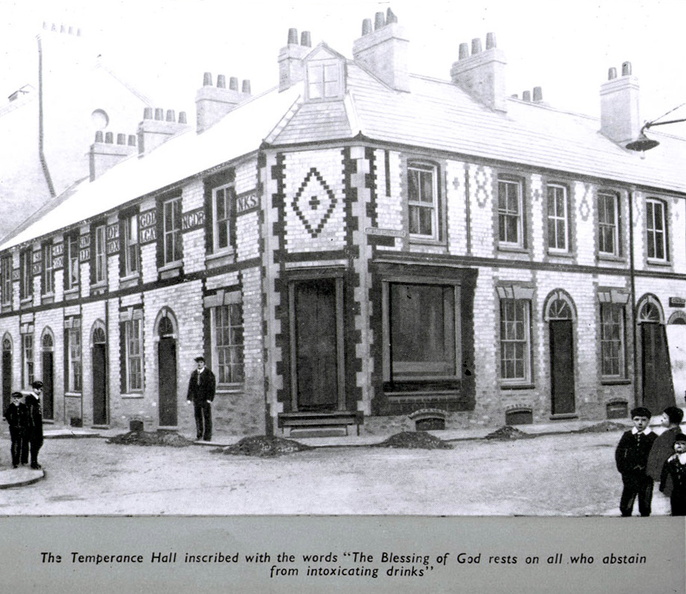
Temperance Hall, Charles Street, Worcester, England
1 The Temperance Hall in Worcester referred to in the Cork Total Abstinence Association meeting is assumed to be the one in Charles Street – the same street as the remaining “Williamson’s Office Block” in Williamson House. [https://cfow.org.uk/picture.php?/5424/category/6/91/89/created-monthly-list-1900]
images are subject to copyright restrictions. “However, please feel
free to use them for research and educational purposes. Any images used
should clearly acknowledge their source.”]
However, the Worcester People and Places website, says:
At the corner of Providence Street and Temperance Street stood the Temperance Hall, a large building of two -colour brick, dating from the 1860s. It was remarkable for the text made from letters of coloured brick 2ft. high or over, which ran around the external walls, between the ground and first floor. It read: ‘The Blessing of God Keep Us and Protect Us From All Intoxicating Drinks’
There seems to be some confusion about the location of the Temperance Hall. Temperance Street is agreed but one source states it is at the junction with Charles Street and the other states it is at the junction with Providence Street.
The Ordnance Survey Town Plans (Surveyed: 1884, Published: 1886.) shows the arrangement of Providence Street and Charles Street running parallel (East to West) with Temperance Street on the western edge of the block. The eastern edge of the block (just off the map) is formed by St Paul’s Street/Foundry Street.
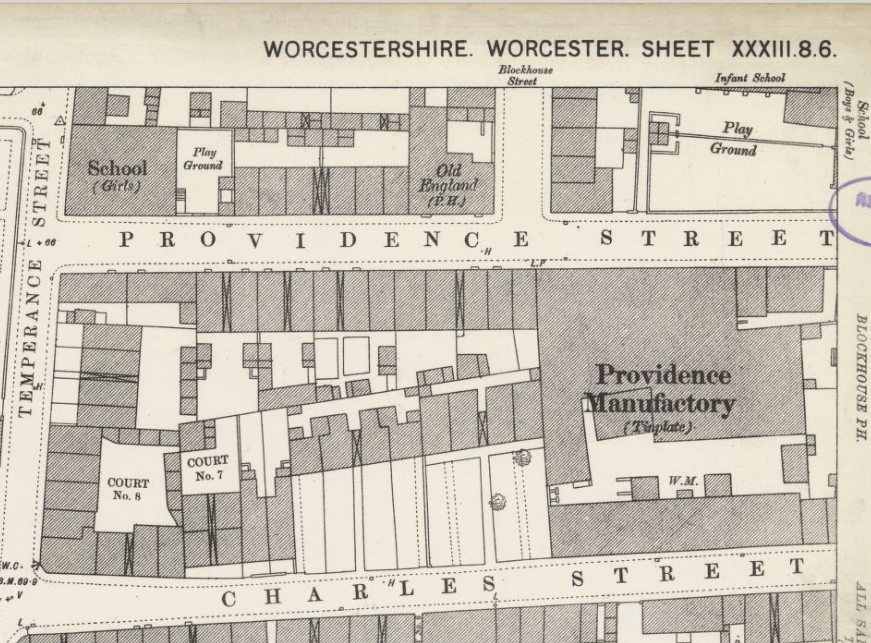
Ordnance Survey, Town Plans of England and Wales, 1840s-1890s, Worcester - Worcestershire XXXIII.8.6
Surveyed: 1884, Published: 1886.
Showing Providence WorksCC-BY (NLS) ‘Reproduced with the permission of the National Library of Scotland’
The truncated corner of the building at the junction of Charles Street and Temperance Street could match the entrance to the Temperance Hall seen in the photograph.
By the time of the publication of the 1947 25 inch Ordnance Survey map, the works take up the entire block, which could be consistent with the demolition of the hall when the works were expanded. The Worcester People and Places website says “It was destroyed in 1900 when Williamson’s Tinplate factory was extended”. By 1890 the firm was known as G.H. Williamson & Sons, William senior having died in 1878 and William junior leaving in 1890. Whether the Williamsons felt that drunkenness was no longer the problem it has been, or whether it was thought that their employees would go to the Central Coffee House Tavern at the Cross is not known.
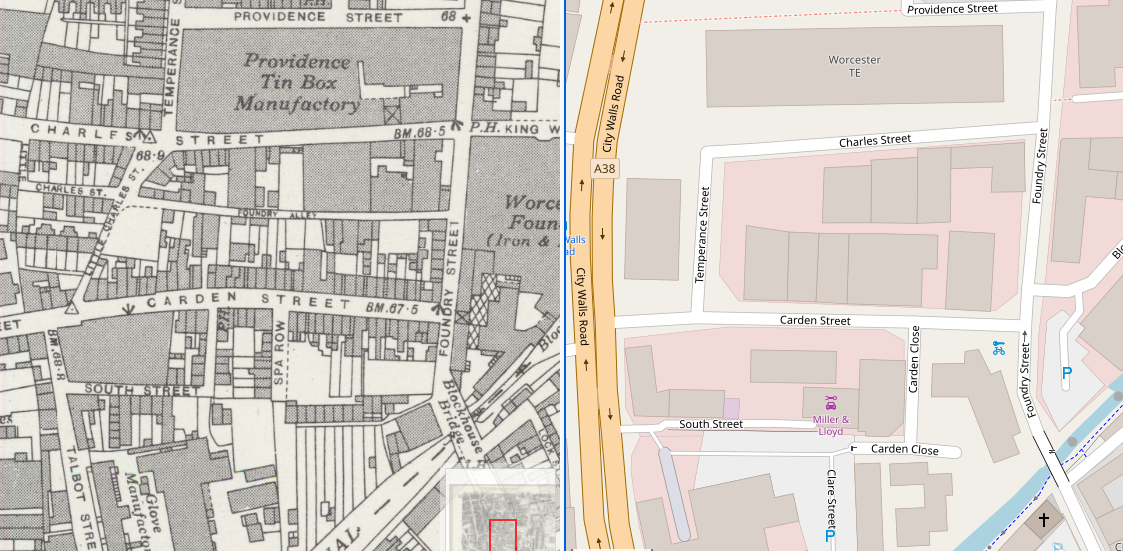
Ordnance Survey: 25 inch Worcestershire XXXIII.8 Revised: 1940, Published: 1947CC-BY (NLS) ‘Reproduced with the permission of the National Library of Scotland’
Right: BT Telephone Exchange 2025
OpenStreetMapCreative Commons Attribution-ShareAlike 2.0 license (CC BY-SA 2.0) OpenStreetMap and its contributors
Drink Related Violence
One of my Williamson cousins indicated that William Blizard Williamson would at one time get blind drunk every fortnight or so (for the hell of it). This would be consistent with his admissions to the Cork Total Abstinence Association meeting in Cork.
My cousin continued, referring to William’s youngest son, “George on one occasion used his mother’s stays so his father broke his stick across his back when beating him. Then great-grandfather (WB senior) came downstairs and said to his wife, ‘go upstairs to George, I’m afraid I’ve killed him’”.
Perhaps George wore his mother’s stays thinking that the whalebone in them would protect his back when his father thrashed him (across his back rather than across his bottom). This might indicate that he was used to receiving (or at least being threatened with) a thrashing.
Searching the internet (with care to get only suitable results returned), it looks as if by the 1840s “stays” had been replaced by “corsets” – but they still had whalebone in them. Might a woman from Ireland have been still wearing stays?
Could William Blizard Williamson the elder not have realised that his son had taken precautions, trashed him, but then (whilst drunk) taken fright when he saw bone appearing through the back of his son’s shirt?
What age might George have been? Say a minimum of 5; that would imply that William Blizard Williamson the elder was still a drunk in 1850. The “Providence Works” was completed in 1858. The naming of the works might have had nothing to do with him finding redemption – or tell us that by then he was reformed. We need to find if the works was named after the street or the street after the works.
We know from the Cork meeting in 1869 that by then he had taken the pledge, was resolutely keeping to it, and then “prosperity beamed upon him”.